
The Coiled Spring: A Misunderstood Monopoly Trading at 2x EBITDA
Executive Summary
President Trump’s “Increasing Medical Marijuana and Cannabidiol Research” Executive Order, which reclassifies cannabis as a Schedule III drug, represents a seismic shift for the cannabis industry. The removal of Section 280E will unlock billions in advertising spend that has been effectively suppressed by punitive tax treatment. Weedmaps (NASDAQ: MAPS) stands as the primary beneficiary of this regulatory tailwind, holding a monopolistic market share in an industry poised for an advertising renaissance.
Current Valuation (as of writing)
Price: $0.86
Fully Diluted Shares: 157MM
Market Cap: $136MM
Net Cash: $63MM
Enterprise Value: $74MM
2024 Revenue: $186MM
EV/Sales: 0.4x
EV/EBITDA: ~2.0x
Investment Thesis
Weedmaps represents a rare combination of monopolistic market position, embedded regulatory moats, and compelling valuation in a sector on the cusp of transformation. The company trades at a substantial discount to intrinsic value, with multiple paths to value realization over the next 12-24 months.
Three Core Pillars
1. Dominant Market Position with Network Effects
Weedmaps has established an unassailable competitive position in cannabis advertising:
40%+ of all U.S. dispensaries are paying advertisers on the platform
90% market share in California, the largest cannabis market, demonstrating utility-like dominance
7.5MM+ monthly active users creating a two-sided marketplace that becomes more valuable with each participant
15-16MM total monthly active users across all touchpoints
This isn’t simply market share; it’s a self-reinforcing network effect. Consumers go to Weedmaps because that’s where the dispensaries are. Dispensaries advertise on Weedmaps because that’s where the consumers are. New entrants face a chicken-and-egg problem that becomes progressively harder to solve as MAPS entrenches its position.
2. Proprietary Data and Regulatory Moat
Beyond network effects, Weedmaps has constructed multiple barriers to competition:
Data Moat: Years of accumulated user reviews, regional pricing data, strain information, and consumer behavior patterns have created a proprietary dataset that cannot be replicated overnight. This data informs everything from product recommendations to pricing strategies for dispensaries, making the platform increasingly indispensable.
Regulatory Expertise: The cannabis regulatory landscape is a labyrinth of federal, state, and local compliance requirements that vary dramatically by jurisdiction. MAPS has built the infrastructure, processes, and institutional knowledge to navigate this complexity at scale. New entrants must either invest years building similar capabilities or risk catastrophic compliance failures. This creates a formidable soft moat that compounds over time.
3. Compelling Valuation with Multiple Value Realization Paths
At $74MM enterprise value with $186MM in 2024 trailing revenue, MAPS trades at:
0.4x EV/Sales
2.0x EV/EBITDA
The company sits on $63MM in net cash (46% of market cap) with no debt, providing substantial downside protection and strategic optionality.
The Section 280E Catalyst: A Hidden Lever Worth Billions
Understanding the Current Tax Penalty
Section 280E of the Internal Revenue Code prohibits businesses trafficking in Schedule I or II controlled substances from deducting ordinary business expenses. This creates a perverse economic distortion:
Current Reality:
Dispensary generates $100,000 in revenue
Operating expenses (COGS): $60,000
Advertising spend on MAPS: $10,000
Other operating expenses: $20,000
Net income: $10,000
Tax Treatment:
Taxable income: $40,000 (can only deduct COGS)
Tax bill (35% rate): $14,000
After-tax profit: -$4,000
The dispensary loses money despite generating positive EBITDA. The $10,000 advertising spend effectively costs $13,500 in real economic terms because it increases taxable income without providing a corresponding deduction.
Post-Reclassification Economics
Once cannabis moves to Schedule III and Section 280E no longer applies:
New Reality:
Same revenue and expenses as above
Taxable income: $10,000 (all expenses deductible)
Tax bill (25% rate): $2,500
After-tax profit: $7,500
The $10,000 advertising spend now costs only $7,500 in after-tax dollars, an effective 44% discount on advertising expenses.
The Unlock for Weedmaps
This isn’t theoretical. The regulatory change creates several powerful dynamics:
Budget Expansion: Dispensaries that previously couldn’t justify advertising spend due to tax inefficiency will suddenly find marketing highly ROI-positive. A dispensary spending $5,000/month on MAPS pre-280E could rationally increase to $10,000+/month post-280E while maintaining the same after-tax cost structure.
Price Elasticity: MAPS operates a “Featured Listings” auction model where dispensaries bid for premium placement. As the effective cost of advertising decreases by 40%+, dispensaries can bid higher for the same ROI. Weedmaps can capture this surplus through higher auction clearing prices without losing customers.
Market Expansion: Thousands of small and mid-sized dispensaries that avoided advertising entirely due to tax considerations will enter the market. MAPS doesn’t need to increase ARPU from existing customers; simply converting non-advertisers to advertisers at current pricing would drive substantial revenue growth.
Conservative Scenario Modeling:
Current paying dispensaries: ~4,000 (40% of 10,000 U.S. dispensaries)
Average monthly ARPU: ~$3,900 ($186MM annual / 4,000 customers / 12 months)
Post-280E scenarios:
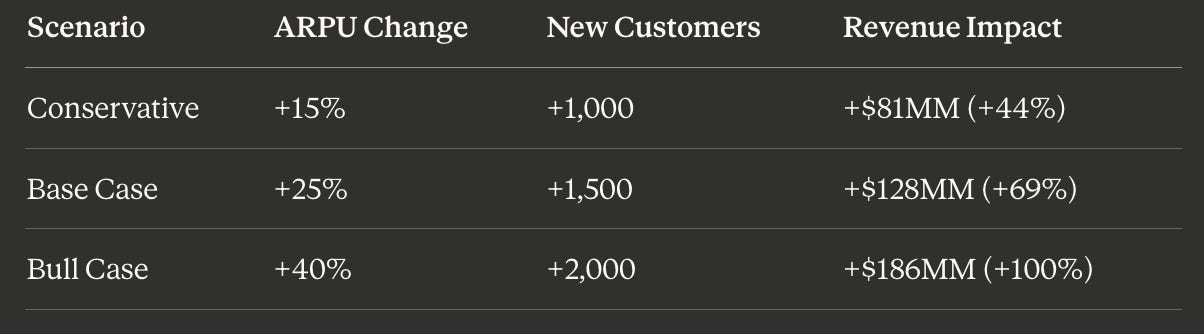
Even the conservative scenario would more than double the current enterprise value at current multiples.
Business Model Deep Dive
Revenue Streams
1. Monthly Subscriptions (Core SaaS)
Retailers pay for basic marketplace presence
Tiered pricing based on location, features, and visibility
High retention due to switching costs and network effects
2. Advertising Solutions
Featured listings in search results (auction-based)
Deal promotions and special offers
Banner advertisements
Performance marketing tools
3. WM Business Suite (Enterprise Software)
Point-of-sale integration
WM Store (e-commerce backend)
Compliance and regulatory software
Menu management tools
Unit Economics
While MAPS doesn’t disclose granular customer-level data, we can estimate:
Estimated ARPU: $3,900/month or $47,000/year
Estimated CAC: $2,000-3,000 (mostly inside sales)
Estimated Payback Period: 6-9 months
Estimated Gross Margin: 75-80%
LTV/CAC Ratio: 15-20x (estimated)
These are healthy unit economics for a software business.
The Path to Value Realization
For MAPS to reach fair value (conservatively 4x EV/EBITDA), the company needs to execute on one or more of three paths:
Path 1: Operational Excellence (Cost Reduction)
The Problem: MAPS currently employs approximately 450 people with a median salary of around $120,000. General and administrative costs increased by over $1MM to $17.5MM in Q3 2025. The company has ~25 open positions on LinkedIn, including non-essential roles like Product Designers.
The Opportunity: Software businesses can operate remarkably lean. The company doesn’t handle physical product, logistics, or payments; it’s pure software and marketplace operations.
Proposed Actions:
Immediate hiring freeze on all non-essential positions (saves $3MM+ annually)
10-20% headcount reduction through role consolidation, offshore migration of certain functions, and elimination of redundancy
Compensation benchmarking to ensure salaries align with market rather than inflated SPAC-era expectations
Streamlined management layers to reduce bureaucracy and increase decision velocity
Financial Impact:
Current headcount cost: ~$54MM annually (450 × $120K)
15% reduction: Saves $8.1MM
EBITDA improvement: +$8MM (increasing margin by 4%)
At 5x EBITDA multiple: +$40MM in market cap (+29%)
This isn’t speculative. Twitter (now X) famously cut 50%+ of headcount with minimal operational disruption. MAPS doesn’t need to go that far; even modest optimization would dramatically improve profitability.
Path 2: Revenue Acceleration (280E Removal)
As detailed in the Section 280E section above, the regulatory change creates a natural inflection point for advertising spend. MAPS doesn’t need to innovate or execute perfectly; it simply needs to maintain its platform and allow market forces to drive increased spend.
Key Execution Points:
Maintain platform stability and user experience
Gradually increase Featured Listing auction floors as bid density increases
Launch targeted sales campaigns to dormant/non-advertiser dispensaries
Introduce higher-tier subscription packages with premium features
Expand WM Business Suite adoption for incremental revenue
Historical Precedent: MAPS has successfully implemented steep price increases in the past with minimal churn. The cannabis community complained but had no viable alternative. With 280E removal, dispensaries will have even less price sensitivity.
Path 3: Take-Private Transaction
The Setup: Founders Doug Francis and Justin Hartfield attempted a take-private at $1.70/share in December 2024, withdrew in June 2025. This wasn’t a lack of conviction; it was likely a financing or timing issue.
Why It Makes Sense:
Discounted valuation: At $0.86, the company trades at half its previous bid
Cash generation: MAPS is approaching free cash flow positive and doesn’t need public markets for capital
Public market inefficiency: Cannabis stocks trade at depressed multiples due to sector stigma
Founder alignment: Performance RSUs vest at $3.25 and $5.00, suggesting founders believe in materially higher intrinsic value
Potential Acquirers:
Founders + Private Credit firm: Allows founders to maintain control
Management and Governance
Leadership
Doug Francis (CEO & Co-Founder): Serial entrepreneur with deep cannabis industry experience. Co-founded Weedmaps in 2008 and has navigated the company through multiple regulatory environments.
Justin Hartfield (Co-Founder): Business development and strategic vision. Partnership with Francis has endured 15+ years.
Alignment and Incentives
Performance RSUs: Doug Francis has substantial performance-based equity that vests at:
50% at $3.25/share (278% upside)
50% at $5.00/share (481% upside)
This structure creates strong alignment for value creation but also raises questions about motivation to maximize public shareholder value in the near term. Cynically, founders might prefer the stock to languish in the $1-2 range to facilitate a discounted take-private, then unlock value in the private markets.
Shareholder Base: Post-SPAC shareholder base likely includes unmotivated holders with high cost bases looking to exit. Insider ownership concentration means limited free float and potential for volatility.
Financial Analysis
Recent Performance
Q3 2025 Results (most recent):
Revenue: ~$42MM (implying ~$184MM run-rate)
YoY revenue decline: -9%
EBITDA margin: ~18%
The Good:
Still generating positive EBITDA despite headcount bloat
Maintaining 40%+ market share despite revenue decline
Healthy gross margins (75%+) indicate pricing power
Strong balance sheet with $63MM net cash
The Bad:
Revenue is declining, not growing
Operating leverage is moving in the wrong direction (costs rising as revenue falls)
No clear management plan to address profitability
Execution of the take-private failed, creating uncertainty
The Context: The revenue decline likely reflects macro weakness in cannabis retail as the industry digests overexpansion and awaits regulatory clarity. This is temporary and will reverse with 280E removal.
Risk Factors
Execution Risk: MAPS Fails to Capture 280E Value
What Could Go Wrong:
Competitors emerge with superior products
Dispensaries diversify advertising spend across multiple platforms
Google/Meta enters cannabis advertising (regulatory uncertainty makes this unlikely near-term)
Price increases trigger mass exodus to alternatives
Mitigation:
Network effects and switching costs protect the incumbent position
MAPS has successfully raised prices before without material churn
10+ year head start provides a durable competitive advantage
Probability: Low-Medium (20-30%)
Operational Risk: Management Fails to Cut Costs
What Could Go Wrong:
Founder-operators resist difficult personnel decisions
Employee activism or PR concerns prevent layoffs
Revenue decline accelerates, necessitating even deeper cuts
G&A costs continue to climb despite shrinking top line
Mitigation:
Board pressure and activist shareholders could force action
Continued stock underperformance makes take-private less feasible, forcing public market discipline
Performance RSUs incentivize management to reach $3.25/$5.00 targets
Probability: Medium (30-40%)
Regulatory Risk: 280E Removal Delayed or Diluted
What Could Go Wrong:
Schedule III reclassification faces legal challenges
Federal bureaucracy delays implementation for years
Final regulations include carve-outs that preserve some 280E restrictions
New regulations impose different burdens (e.g., advertising restrictions)
Mitigation:
Executive Order provides strong political will for change
Industry momentum and bipartisan support make a reversal unlikely
Even without 280E removal, MAPS trades at a compelling valuation
International expansion (Canada, Europe) provides growth optionality
Probability: Low-Medium (15-25%)
Market Risk: Cannabis Sector Remains Pariah
What Could Go Wrong:
Broader market de-rates cannabis stocks regardless of fundamentals
Public market investors refuse to underwrite cannabis exposure
Private market financing remains unavailable for take-privates
Stock continues to trade at 1-2x EBITDA despite improving fundamentals
Mitigation:
Sector stigma already priced in at 2x EBITDA
Federal reclassification could catalyze institutional investment
Cash balance and path to FCF positive reduce dependency on external capital
Take-private by strategics (non-cannabis) could recognize value
Probability: Medium (30-40%)
Competition Risk: Google or Meta Enter Cannabis
What Could Go Wrong:
Federal reclassification allows major platforms to accept cannabis ads
MAPS loses dominant position as dispensaries shift spend to higher-ROI channels
Google Maps/Search becomes the primary discovery tool for consumers
Revenue collapses as MAPS becomes obsolete
Mitigation:
Even as Schedule III, federal illegality creates compliance complexity, major platforms avoid
Cannabis-specific features (strain data, compliance tools) create sticky value beyond advertising
Local/regional focus gives MAPS an advantage over national platforms
Major platforms may choose to avoid cannabis for brand/regulatory risk reasons
Probability: Low (10-20%)
Management Misalignment Risk: Value Captured in Take-Private
What Could Go Wrong:
Founders deliberately suppress stock price to facilitate a cheap take-private
Minority shareholders forced to sell at $1.50-2.00 while founders capture $5+ value privately
Special Committee fails to adequately protect public shareholders
Fairness opinion rubber-stamps inadequate offer
Mitigation:
Fiduciary duties and Delaware corporate law provide some protection
Prior take-private attempt at $1.70 was withdrawn, suggesting the Special Committee pushed back
A vocal shareholder base can pressure for fair treatment
Founders’ performance RSUs at $3.25/$5.00 suggest they believe a public path to value exists
Probability: Medium (25-35%)
Investment Strategy and Position Sizing
Catalyst Timeline
Near-Term (0-6 months):
Q4 2025/Q1 2026 earnings for signs of stabilization
Management commentary on cost structure and profitability
Schedule III reclassification formal implementation timeline
Any take-private approaches or strategic alternatives
Medium-Term (6-18 months):
280E removal takes effect, advertising budgets expand
Revenue reacceleration becomes evident in quarterly results
Cost reduction initiatives show impact on margins
Stock re-rates as fundamentals improve
Long-Term (18-24 months):
Sustained growth trajectory established
The path to ramp EBITDA margins is clear
Multiple expansion toward the software peer group
Potential strategic M&A as value becomes undeniable
Conclusion
Weedmaps represents a classic special situation: a monopolistic business trading at a fraction of intrinsic value due to sector stigma, temporary operational challenges, and public market inefficiency. The combination of 40%+ market share, embedded regulatory moats, fortress balance sheet, and imminent regulatory tailwinds creates asymmetric upside.
At 2x EBITDA with $63MM in net cash, downside appears well-protected. Even modest operational improvement or revenue stabilization would drive 50-100% upside. If 280E removal catalyzes meaningful advertising budget expansion, 200-400% returns are achievable over 18-24 months.
The primary risks center on execution—both operational (cost management) and strategic (280E monetization). Management’s mixed track record and failed take-private attempt introduce uncertainty. However, the Performance RSU structure at $3.25/$5.00 suggests founders recognize substantially higher value and have strong incentives to deliver.
For investors comfortable with cannabis sector exposure, operational turnaround risk, and a 12-24 month time horizon, MAPS offers one of the most compelling risk-reward profiles in small-cap software.
In Doug We Trust...
Disclaimer: This is not investment advice. Conduct your own due diligence and consult with financial professionals before making investment decisions. The author may hold positions in securities discussed.